Nur in Englisch verfügbar
-
Andreas Nitsche (2026).
Process-Embedded Liquid Democracy: Complementary Delegation and Adaptive Representation.
Preprint. Zenodo.
DOI: doi.org/10.5281/zenodo.22746745
[News]
-
Davide Grossi, Andreas Nitsche, and Georgios Papasotiropoulos (2026).
Modeling Liquid Democracy: A Survey of the (Computational) Social Choice Literature.
Proceedings of the Thirty-Fifth International Joint Conference on Artificial Intelligence, IJCAI-26.
DOI: doi.org/10.24963/ijcai.2026/872
[News]
-
Davide Grossi, Andreas Nitsche, Georgios Papasotiropoulos, Oskar Skibski, Piotr Skowron, and Tomasz Wąs (2026).
Power in Liquid Democracy: A Network Centrality Approach.
DOI: 10.48550/arXiv.2608.13188.
[Publication page]
[Paper on arXiv]
[News]
-
Jan Behrens and Björn Swierczek (2025).
Multi-dimensional voting beyond peak-preferences.
Prepublication.
[Prepublication]
-
Jan Behrens, Axel Kistner, Andreas Nitsche, and Björn Swierczek (2025).
How Aggregation Functions in Mass-Deliberation Systems Can Incentivize Extremes: A Hypothesis on Strategy-Induced Opinion Polarization.
Prepublication.
[Prepublication]
-
Davide Grossi and Andreas Nitsche (2025).
Delegations as Adaptive Representation Patterns: Rethinking Influence in Liquid Democracy.
arXiv.
DOI: 10.48550/arXiv.2506.09789.
[Paper on arXiv]
[News]
-
Davide Grossi, Ulrike Hahn, Michael Mäs, Andreas Nitsche, Jan Behrens, Niclas Boehmer, Markus Brill, Ulle Endriss, Umberto Grandi, Adrian Haret, Jobst Heitzig, Nicolien Janssens, Catholijn M. Jonker, Marijn A. Keijzer, Axel Kistner, Martin Lackner, Alexandra Lieben, Anna Mikhaylovskaya, Pradeep K. Murukannaiah, Carlo Proietti, Manon Revel, Élise Rouméas, Ehud Shapiro, Gogulapati Sreedurga, Björn Swierczek, Nimrod Talmon, Paolo Turrini, Zoi Terzopoulou, and Frederik Van De Putte (2024).
Enabling the Digital Democratic Revival: A Research Program for Digital Democracy.
DOI: 10.48550/arXiv.2401.16863.
[News]
-
Ulrike Hahn, Michael Mäs, and Andreas Nitsche (2023).
Innovations in Equity: Contextualizing U.S. and International Perspectives | Germany and Europe.
Transcript of contributions to National Coalition for Equity Impact Summit #2.
[Transcript]
[News]
-
Andreas Nitsche (2022).
Crossing the Pond: Interactive Democracy and Social Cohesion in a Polarized Society.
The Liquid Democracy Journal, Issue 7.
[Article in The Liquid Democracy Journal]
-
Andreas Nitsche (2022).
Algorithms for Good.
The Liquid Democracy Journal, Issue 7.
[Article in The Liquid Democracy Journal]
-
Jan Behrens, Axel Kistner, Andreas Nitsche, and Björn Swierczek (2022).
Implementation Issues of Collective Decision Systems in Practice.
The Liquid Democracy Journal, Issue 7.
[Article in The Liquid Democracy Journal]
-
Jan Behrens, Axel Kistner, Andreas Nitsche, and Björn Swierczek (2022).
The Temporal Dimension in the Analysis of Liquid Democracy Delegation Graphs.
The Liquid Democracy Journal, Issue 7.
[Article in The Liquid Democracy Journal]
[News]
-
Martin Kaplan and Andreas Nitsche (2022).
Communicating Across Political Fault Lines – Reaching the 'Unreachable'.
Video conversation, Thomas Mann House, Los Angeles.
[Video]
-
Thomas Mann House (2022).
An Interview with 2022 Thomas Mann Fellow Andreas Nitsche.
Video interview.
[News]
-
Thomas Mann House (2022).
Restoring Public Trust.
Program featuring Andreas Nitsche, Thomas Mann House, Los Angeles.
[News]
-
Andreas Nitsche (2021).
Liquid Democracy—A Transatlantic Affair.
Film, Thomas Mann House, Los Angeles.
[Film]
-
Guido Boella, Louise Francis, Elena Grassi, Axel Kistner, Andreas Nitsche, Alexey Noskov, Luigi Sanasi, Adriano Savoca, Claudio Schifanella, and Ioannis Tsampoulatidis (2018).
WeGovNow: A Map Based Platform to Engage the Local Civic Society.
Companion of The Web Conference 2018, pp. 1215–1219.
DOI: 10.1145/3184558.3191560.
[Paper at ACM Digital Library]
-
Jan Behrens (2018).
Practical Consequences of Arrow's Theorem for Open Electronic Voting.
The Liquid Democracy Journal, Issue 6.
[Article in The Liquid Democracy Journal]
-
Jan Behrens and Björn Swierczek (2018).
Unified User Management with LiquidFeedback.
The Liquid Democracy Journal, Issue 6.
[Article in The Liquid Democracy Journal]
-
Andreas Nitsche (2018).
Roadmap to a Decentralized LiquidFeedback.
The Liquid Democracy Journal, Issue 6.
[Article in The Liquid Democracy Journal]
-
Jan Behrens, Axel Kistner, Andreas Nitsche, and Björn Swierczek (2018).
The LiquidFeedback Blockchain.
The Liquid Democracy Journal, Issue 6.
[Article in The Liquid Democracy Journal]
-
Jan Behrens, Andreas Nitsche, and Björn Swierczek (2018).
Decentralized Accreditation.
The Liquid Democracy Journal, Issue 6.
[Article in The Liquid Democracy Journal]
-
Jan Behrens (2017).
The Origins of Liquid Democracy.
The Liquid Democracy Journal, Issue 5.
[Article in The Liquid Democracy Journal]
-
Jan Behrens and Björn Swierczek (2017).
A Fair Distance Function.
The Liquid Democracy Journal, Issue 5.
[Article in The Liquid Democracy Journal]
-
Jan Behrens, Andreas Nitsche, and Björn Swierczek (2017).
LiquidFeedback's Issue Limiter.
The Liquid Democracy Journal, Issue 5.
[Article in The Liquid Democracy Journal]
-
The developers of LiquidFeedback (2017).
Readers of the Journal Asked – LiquidFeedback Developers Answer (#2).
The Liquid Democracy Journal, Issue 5.
[Article in The Liquid Democracy Journal]
-
Andreas Nitsche (2017).
Warum Liquid Democracy keine Alternative zur parlamentarischen Republik ist.
vorwärts.
[Article in vorwärts]
-
Jan Behrens (2016).
A Mathematical View on the Sockpuppet Problem.
[Facsimile in The Liquid Democracy Journal]
-
Björn Swierczek (2015).
Democratic File Revision Control with LiquidFeedback.
The Liquid Democracy Journal, Issue 4.
[Article in The Liquid Democracy Journal]
-
Jan Behrens, Andreas Nitsche, and Björn Swierczek (2015).
A Finite Discourse Space for an Infinite Number of Participants.
The Liquid Democracy Journal, Issue 4.
[Article in The Liquid Democracy Journal]
-
Jan Behrens (2015).
Addendum to our Theorem Regarding Preferential Delegation and Negative Voting Weight.
The Liquid Democracy Journal, Issue 4.
[Article in The Liquid Democracy Journal]
-
Jan Behrens and Björn Swierczek (2015).
Preferential Delegation and the Problem of Negative Voting Weight.
The Liquid Democracy Journal, Issue 3.
[Article in The Liquid Democracy Journal]
-
Jan Behrens (2015).
Circular Delegations – Myth or Disaster?.
The Liquid Democracy Journal, Issue 3.
[Article in The Liquid Democracy Journal]
-
Axel Kistner and Björn Swierczek (2014).
Über die Zulässigkeit offener Abstimmungen in politischen Parteien in der Bundesrepublik Deutschland.
[Publication page]
-
Andreas Lange (2014).
LiquidFeedback: Gamification of Politics?.
The Liquid Democracy Journal, Issue 2.
[Article in The Liquid Democracy Journal]
-
Jan Behrens (2014).
Game of Democracy.
The Liquid Democracy Journal, Issue 2.
[Article in The Liquid Democracy Journal]
-
Björn Swierczek (2014).
Dividing the Pie – Visualizing Quantities and Qualities of Majorities in Pie Charts.
The Liquid Democracy Journal, Issue 2.
[Article in The Liquid Democracy Journal]
-
Jan Behrens (2014).
How Chaos Protected the Status Quo (more than we intended to).
The Liquid Democracy Journal, Issue 2.
[Article in The Liquid Democracy Journal]
-
Jan Behrens (2014).
Search for a Tie-breaker.
The Liquid Democracy Journal, Issue 2.
[Article in The Liquid Democracy Journal]
-
Andreas Nitsche (2014).
Liquid Democracy Provides No Alternative to the Republic.
The Liquid Democracy Journal, Issue 2.
[Article in The Liquid Democracy Journal]
-
Jan Behrens (2014).
Liquid Democracy for Civic Participation – A View on LiquidFriesland.
The Liquid Democracy Journal, Issue 2.
[Article in The Liquid Democracy Journal]
-
The developers of LiquidFeedback (2014).
Readers of the Journal Asked – LiquidFeedback Developers Answer (#1).
The Liquid Democracy Journal, Issue 2.
[Article in The Liquid Democracy Journal]
-
Andreas Nitsche (2014).
Liquid Democracy - what all the noise is about.
The Liquid Democracy Journal, Issue 1.
[Article in The Liquid Democracy Journal]
-
Björn Swierczek (2014).
Five years of Liquid Democracy in Germany.
The Liquid Democracy Journal, Issue 1.
[Article in The Liquid Democracy Journal]
-
Björn Swierczek (2014).
Fünf Jahre Liquid Democracy in Deutschland.
The Liquid Democracy Journal, Issue 1.
[Article in The Liquid Democracy Journal]
-
Jan Behrens (2014).
The evolution of proportional representation in LiquidFeedback.
The Liquid Democracy Journal, Issue 1.
[Article in The Liquid Democracy Journal]
-
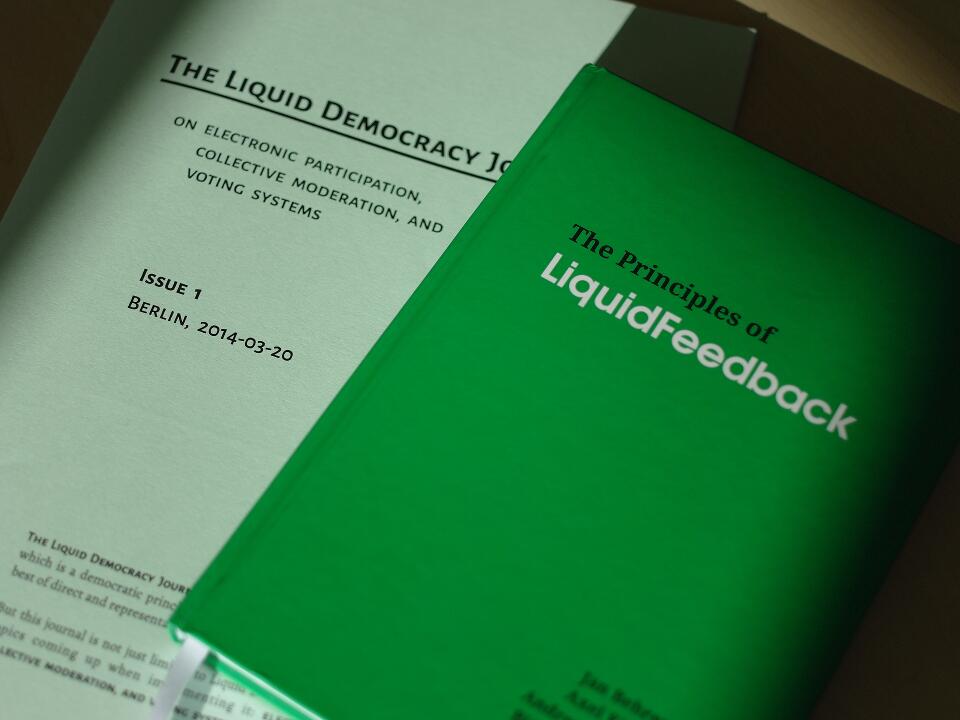
Jan Behrens, Axel Kistner, Andreas Nitsche, and Björn Swierczek (2014).
The Principles of LiquidFeedback.
Interaktive Demokratie e. V., Berlin.
ISBN 978-3-00-044795-2.
[Book website]